
AI is forcing education to confront an uncomfortable question: if a machine can remove some of the work involved in learning, which work should we actually fight to preserve?
For most of educational history, effort has been treated as a reasonable proxy for learning. A difficult assignment took longer. A serious piece of research required more searching. A sophisticated analysis demanded more calculation. The friction was part of the process, and because there was no practical way to separate useful friction from useless friction, we often treated all of it as educationally valuable.
Technology has been quietly dismantling that assumption for decades.
Calculators removed much of the mechanical burden of arithmetic. Search engines reduced the cost of finding information. Spreadsheets compressed hours of calculation into seconds. Statistical software made analyses possible that would once have required teams of researchers. None of these technologies eliminated the need to think. Instead, they changed where thinking was economically worth spending.
Generative AI takes this progression much further. It does not merely retrieve information or calculate a formula. It can summarize, restructure, compare, translate, brainstorm, explain and increasingly participate in analytical work itself. That makes the question facing education more difficult than whether students should or should not use AI.
The more interesting question is what kinds of thinking we should deliberately stop asking humans to spend time on.
Consider a finance student given sixty minutes to analyze a company. In a traditional workflow, twenty minutes might disappear into finding numbers across annual reports, another fifteen into cleaning the data, ten into calculating ratios, ten into interpreting the results, and perhaps five into questioning the conclusion.
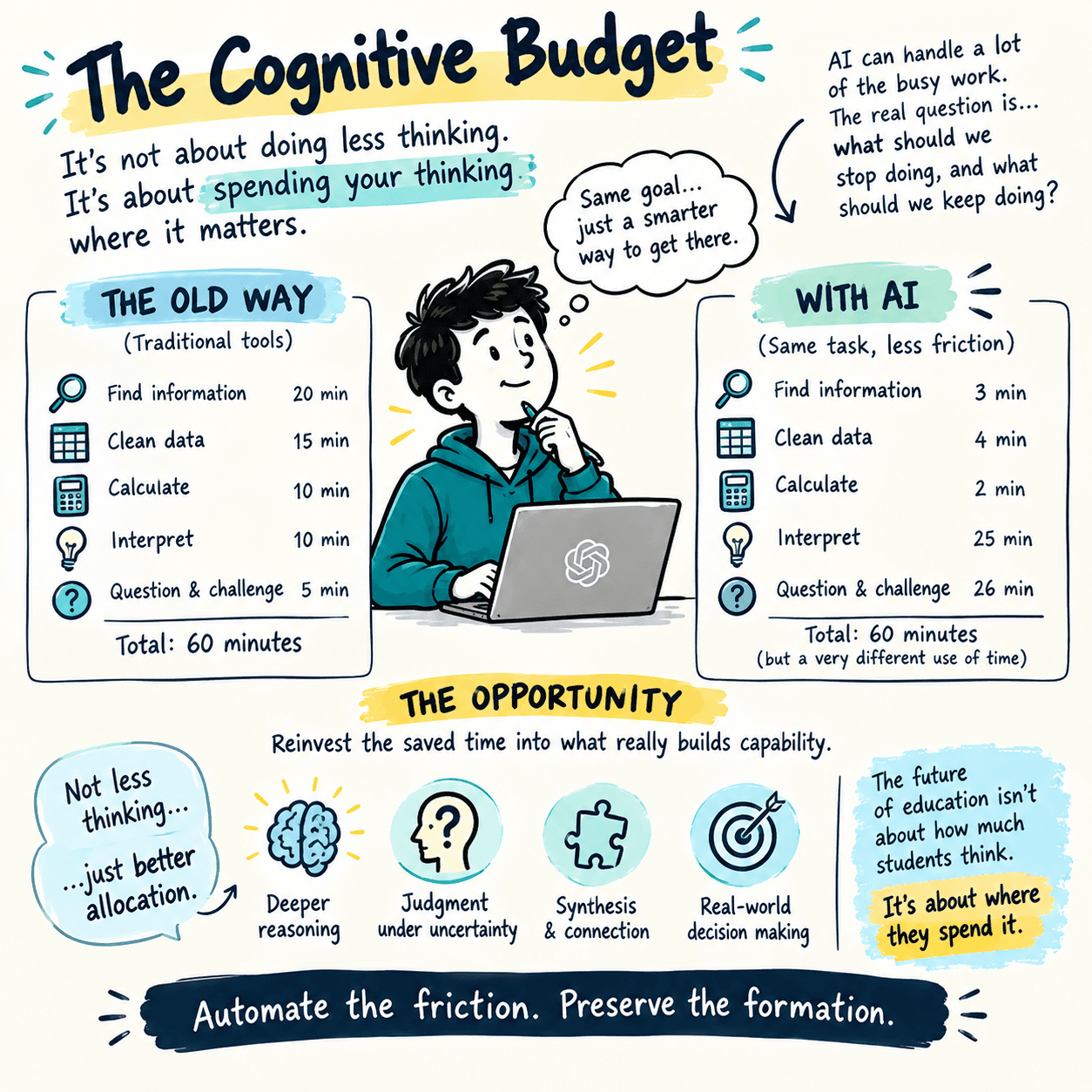
Now introduce capable technology. Data collection takes three minutes. Cleaning takes four. Calculation takes two.
The student has effectively been given more than half an hour back.
What should education do with those thirty-six minutes?
One option is to recreate the old friction artificially. We could prohibit the tools, require the student to collect every number manually and congratulate ourselves for preserving rigor.
There is another possibility. We could reinvest those thirty-six minutes into harder questions.
Why did margins collapse despite revenue growth? Which assumption carries most of the valuation? What evidence contradicts the investment thesis? What would have to happen for this apparently cheap company to become expensive? Which number in the entire model deserves the least confidence?
The workload has not disappeared. It has moved.
And that distinction may become central to assessment in the AI era.
Recent research gives us a useful language for thinking about this. A 2026 study of doctoral learners examining cognitive offloading with generative AI found that AI could lower the barrier to entering complex work while learners continued to read, verify and reconstruct ideas themselves. The pattern became more problematic when core conceptual or methodological reasoning itself was transferred to the system.
That suggests cognitive offloading is not inherently the enemy of learning.
The important distinction may be between removing friction and removing formation.
Imagine two kinds of difficulty. The first is finding forty numbers scattered through several annual reports and manually transferring them into a spreadsheet. The second is deciding which three of those numbers fundamentally change your view of the company.
Both consume cognitive effort. But they do not necessarily create equivalent educational value.
This gives us a useful concept for thinking about assessment: the cognitive budget.
Every student enters an assignment with finite attention, working memory, time and mental energy. An assessment effectively decides where that scarce cognitive capacity will be spent. Some of it goes toward retrieving information. Some goes toward processing and organizing it. Some goes toward reasoning. And some goes toward judgment: deciding what matters, evaluating uncertainty and taking responsibility for a conclusion.
Historically, retrieval and processing consumed a large portion of that budget because technology could not eliminate them cheaply.
AI changes the economics.
If machines dramatically reduce the cognitive cost of retrieval and routine processing, education has a choice. We can allow the saved capacity to disappear, producing easier assignments. Or we can deliberately reinvest it in reasoning and judgment, producing different kinds of difficult assignments.
This leads to a counterintuitive possibility: the best AI-enabled assessment might involve less work but more thinking.
Consider two finance exams.
In the first, students spend forty-five minutes calculating twenty-five financial ratios manually.
In the second, all twenty-five ratios are already calculated correctly. Students may use AI. Their task is to identify the three ratios that matter most, construct an investment thesis, identify the strongest argument against their own thesis, determine which assumption introduces the greatest uncertainty, and specify what new evidence would cause them to reverse their conclusion.
The second exam contains less mechanical labor. Yet it may require substantially more judgment.
That is not necessarily making education easier. It is relocating difficulty toward the capability we actually care about developing.
A broader 2026 systematic review of generative AI and cognitive load points in a similar direction. The effects of AI on learning are not uniformly beneficial or harmful; they depend on factors including task design, scaffolding, prior knowledge and how the technology is used. The implication is important. “AI use” is too crude a variable for understanding what is happening educationally. We need to examine which cognitive operations are being delegated and which remain with the learner.
This also suggests that AI literacy may eventually mean something deeper than knowing how to write a good prompt.
It may mean knowing how to allocate cognition.
Two students could use exactly the same AI system and perform completely different intellectual work. One might delegate the entire task and accept the result. Another might delegate information gathering, independently verify the sources, challenge the model's assumptions, request counterarguments, compare competing explanations and retain responsibility for the final judgment.
Both technically “used AI.”
But that description tells us almost nothing about what either student actually did.
The ability to decide what should be delegated, what must be verified, where uncertainty matters and which decisions require human judgment may itself become an important professional capability. Doctors, analysts, engineers, lawyers, accountants and managers will increasingly operate alongside systems capable of performing substantial portions of their traditional workflows. Their value will not necessarily come from refusing to delegate. It may come from knowing what not to delegate.
That changes the design problem for universities.
The objective should not be to preserve every cognitive task simply because previous generations performed it manually. Nor should the objective be to automate every difficult activity simply because technology can.
A more useful principle is:
Automate the friction. Preserve the formation.
Remove work that consumes attention without developing the capability the course is trying to teach. Then deliberately spend the recovered cognitive budget on interpretation, reasoning, uncertainty, synthesis and judgment.
The calculator did not destroy mathematics by making arithmetic cheaper. The spreadsheet did not destroy finance by making calculations faster. Both technologies changed which human capabilities became valuable.
Generative AI may be beginning the same process at a much deeper cognitive level.
And that means one of the most important questions in education may no longer be how much thinking a student did.
It may be where they chose to spend it.