Oral Assessment in the
Age of AI
Socratic Metric™ addresses the profound challenge of AI-generated content by evaluating live cognition. By requiring users to read questions aloud and respond orally, the platform leverages decades of cognitive neuroscience research to measure genuine comprehension, not just written output.
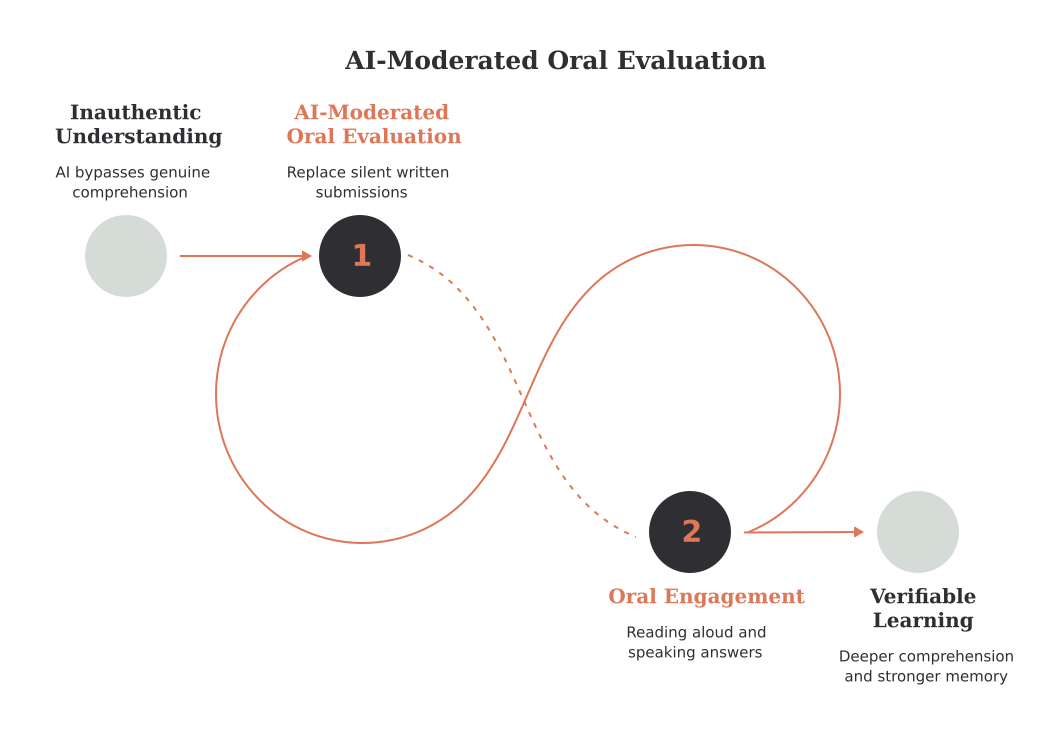
From Static Output to Verified Cognition
Generative AI has fundamentally broken traditional written assessments. To truly verify comprehension in high-stakes environments, we must move from silent reading to AI-moderated oral evaluation.
Evidence of Impact
Multiple peer-reviewed studies support the distinct advantages of oral engagement and the production effect.
Hale et al. (2007)
Found students reading aloud demonstrated significantly higher comprehension than those reading silently, noting a critical limitation of silent reading: "the examiner had no way of knowing if the student was actually reading and/or read the entire passage."
Schiavo et al. (2021)
Demonstrated approximately a 24% improvement in comprehension among students with reading disabilities when utilizing attention-driven read-aloud technology.
Forrin & MacLeod (2018)
Confirmed the memory advantage is particularly strong when learners hear their own voices, demonstrating that self-generated vocal production creates the most distinctive memory encoding.
Addressing the Counter Evidence
Research shows that highly fluent readers can achieve comparable comprehension through silent reading under optimal conditions. This does not refute the value of oral assessment; it clarifies its purpose.
Silent reading optimizes efficiency for low-stakes information processing. Oral reading ensures verifiable comprehension, creates distinctive memory traces, and produces observable evidence of understanding.
Socratic Metric occupies the domain where verifiable authenticity and demonstrable learning are absolute priorities—precisely where traditional assessment fails in the AI age.
Applied Neuroscience at Scale
Socratic Metric translates core neuroscientific principles into practical, scalable cognitive verification technology.
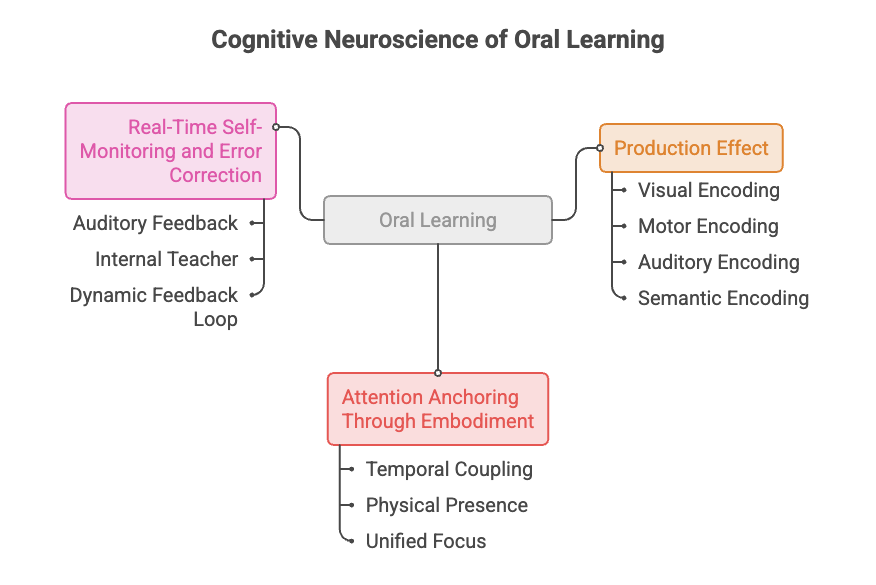
Oral question presentation — Engages visual-motor-auditory integration and anchors attention through embodied focus.
Oral response — Activates the production effect and multimodal encoding pathways, forcing genuine semantic encoding.
Iterative feedback — Provides immediate, adaptive AI-moderated guidance after each response, mirroring the brain's natural learning cycle.
Authenticity verification — Even if users consult AI during preparation, articulating responses in their own voice forces true comprehension and provides identity-verified proof of learning.
Deployed with over 3,000 simultaneous users, proving that the cognitive benefits of oral engagement can scale securely to the institutional level.
Accessibility and Implementation
The platform's advanced speech recognition accommodates diverse speech patterns and strong accents.
Institutions with heavily international cohorts (over 80% non-native speakers) report marked improvements in communication skills.
The untimed, conversational format eliminates traditional testing time-pressure, allowing individuals to engage fully with the material at their own pace.
The Science Behind Oral Learning
Why AI Cannot Replicate This Process
Current generative AI systems can easily produce fluent text without any actual understanding. However, humans speaking aloud must coordinate complex neural systems for motor planning, semantic retrieval, auditory monitoring, and real-time error correction.
This temporally-anchored, multimodal, embodied process cannot be replicated by simple text generation. It requires biological cognition in action. Socratic Metric measures not what a user can have written for them, but what they can articulate, refine, and defend in their own voice.
Traditional assessments increasingly cannot distinguish between genuine human learning and AI-generated output. Socratic Metric provides a neuroscience-grounded verification solution that makes learning visible, auditable, and resistant to AI circumvention.
By requiring live oral engagement, the platform leverages the fundamental principles of how the human brain actually learns, demonstrating true competence through active production, multimodal encoding, and iterative feedback.
As cognitive research demonstrates, comprehension is not silent. It has a voice.
Start with one
session.
See the proof for yourself.
Whether you're assessing students, employees, or personnel, most organizations begin with a single pilot. We handle the questioning, capture, and evaluation — you keep full control over standards, rubrics, and final decisions.