

Imagine this.
A surgeon has just finished medical school with a flawless record. An engineer has just been certified to build the bridge on your morning commute. A commercial pilot has just passed every flight-doctrine exam. A corporate banker has successfully cleared their mandatory anti-money laundering compliance training.
Now, imagine learning that they didn't actually write a single word of their assessments. A generative AI tool did it for them.
Would you still trust the certificate?
Almost everyone answers immediately: "No."
But then comes the uncomfortable, lingering follow-up: How, exactly, would you prove they actually understood the material? Not whether they could hit "submit" on a polished document. But whether the knowledge has actually transformed how they think.
That is a much harder question. And until surprisingly recently, we took it for granted that we already had the answer.
The great scaling mistake
In medieval Europe, the earliest universities rarely trusted written examinations. When it came time to award a degree, they didn't hand a student a piece of parchment and a quill. They sat them down in front of a panel of masters.
The student had to defend their ideas aloud.
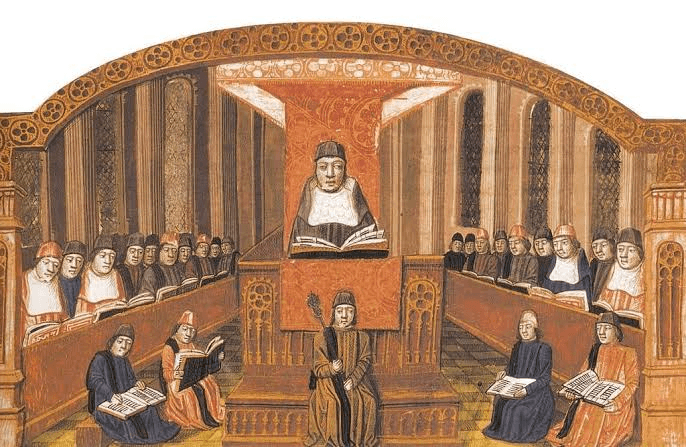
This wasn't because paper was expensive. It was because the scholars of the Middle Ages understood a fundamental law of human psychology: conversation exposes weak thinking faster than a document ever can. You can memorize a paragraph. You can't memorize the capacity to navigate an unexpected question. A skilled examiner only needs one sharp, unscripted follow-up, and an entire house of cards built on rote memorization collapses.
Centuries later, we abandoned that gold standard.
We didn't abandon it because it stopped working; we abandoned it because the world grew too large. Modern society required mass education, multinational corporations, and sprawling regulatory frameworks. Oral examinations don't scale. You cannot assign a panel of expert professors to interview ten thousand undergraduates. A global bank cannot have its compliance leaders personally debate ethics with five thousand remote analysts every quarter.
So, we made a historic trade-off. We chose efficiency over depth. We adopted the standardized written test, the essay, the corporate report, and the multiple-choice quiz.
For a long time, that trade-off made sense. The signal was "good enough" because, for decades, producing fluent, well-structured writing still required an immense amount of human effort and cognitive processing. If a report was coherent, it was safe to assume the writer's brain had wrestled with the concepts.
Then, generative AI arrived.
The democratization of fluency
To understand why the old system is collapsing, we have to look past the panic over cheating. Tools like ChatGPT are extraordinary. They can explain quantum mechanics to a five-year-old, draft ironclad legal contracts, translate complex languages, and summarize five-hundred-page corporate policies in seconds.
That spectacular capability is exactly why the problem exists.
The better AI becomes at writing, the less writing tells us about the writer. Ironically, AI didn't make humans worse at writing; it made writing worse at proving human understanding.
When the written word lost its integrity as a trust mechanism, the immediate instinct across business and academia was to fight fire with fire. Organizations rushed to deploy AI-cheating detection software.
But this approach is trapped in an expensive, defensive loop. AI detectors are forced to play a perpetual game of catch-up against language models that evolve every single month. They try to prove a statistical negative — that a human didn't use a machine — resulting in extreme administrative fatigue, false positives that penalize innocent people, and missed cases from clever prompting.
We are left looking at pristine, automated documents, entirely blind to what is actually happening inside a human being's mind. The fundamental currency of society — trust — has been quietly hollowed out.
The natural consequence: Socratic Metric
That is where Socratic Metric enters the story.
It didn't emerge because the world needed another AI tool to generate text. It emerged because we lost one of our oldest trust mechanisms, and we desperately needed a way to win it back.
Socratic Metric starts from a completely different premise. It doesn't waste energy trying to catch a machine in the act of writing. Instead, it changes the question altogether. Instead of asking, "What document did this person submit?" it asks, "What can this person explain?"
The philosophy behind Socratic Metric is surprisingly old, even if the technology isn't. It takes the un-fakable rigor of the medieval oral defense and uses advanced conversational AI to make it scale to thousands of people simultaneously.
Moving from content to conversation
When an organization uses Socratic Metric, it doesn't hand out a static quiz. It uploads its core knowledge base — whether that's a university syllabus, a complex engineering framework, or an internal corporate compliance manual.
From there, the platform initiates a live, voice-to-voice dialogue.
The AI asks a dynamic question out loud, grounded strictly in the organization's material. The user must respond verbally, in their own words. You can easily copy-paste text into a browser window, but you cannot copy-paste a live, spoken explanation.
As the participant speaks, the platform's underlying engine does something standard chatbots cannot do: it semantically evaluates the reasoning behind the words. If the answer is superficial or sounds like a rehearsed snippet, the AI pushes further. It adapts in real time, asking tailored follow-up questions — "Why do you say that?" or "How would that apply if the circumstances shifted?" — until it maps the exact boundaries of the user's comprehension.
Quantifying the value of spoken truth
This is a massive engineering challenge that goes far beyond building a standard chatbot. A general-purpose consumer tool has no mechanism for voice authentication to verify identity, no capacity to enforce strict content boundaries, and no ability to generate the ironclad data trails required by regulatory frameworks.
By wrapping this adaptive oral workflow in a secure enterprise framework, Socratic Metric has turned the abstract concept of "trust" into a measurable metric. The architecture is ruggedized for high-volume environments, successfully supporting more than 3,000 simultaneous users in live production.
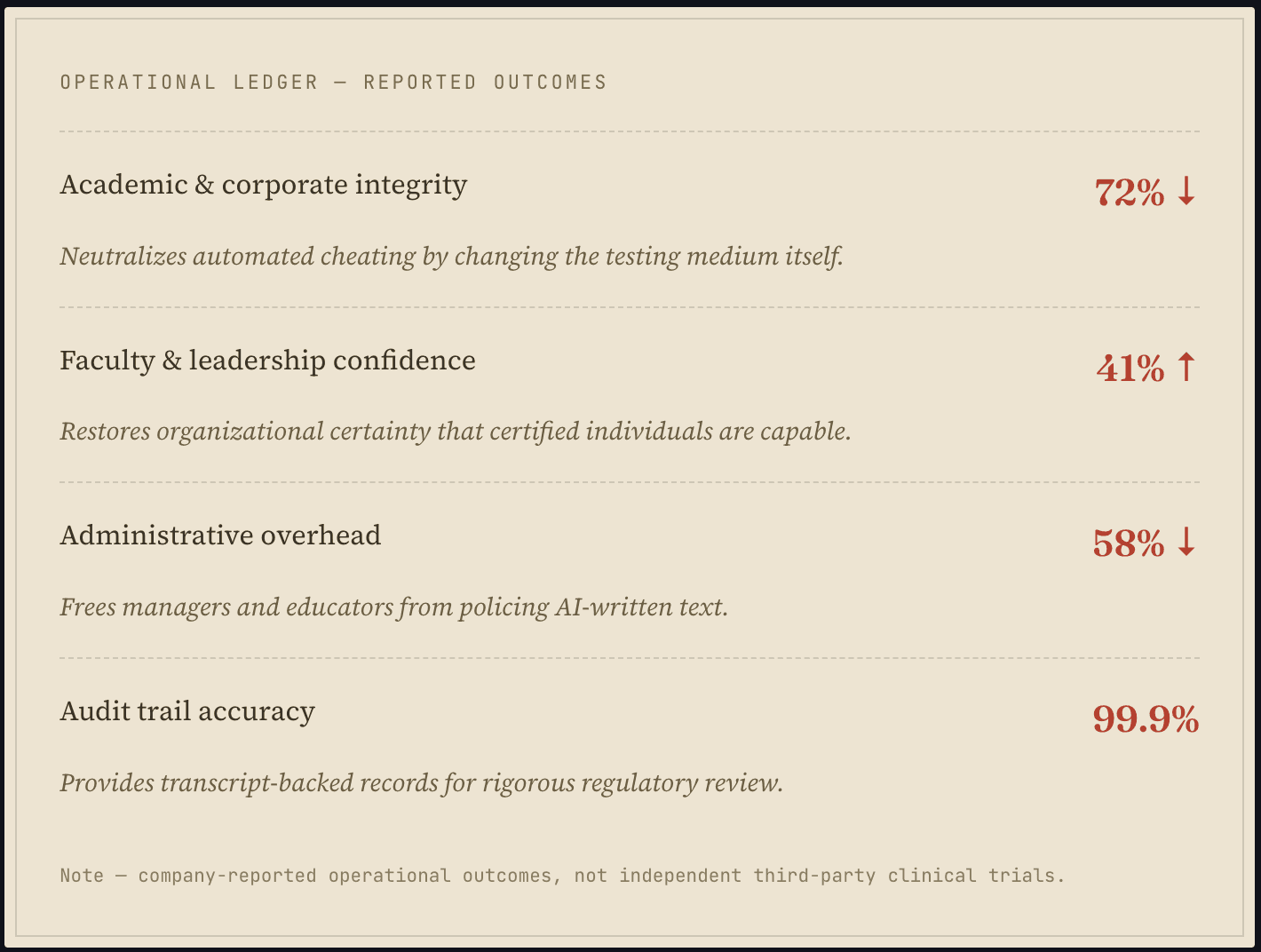
When organizations shift their focus from analyzing static documents to hosting voice-verified, adaptive conversations, the structural shift is immediate:
The new baseline for human competence
Every massive technological leap forces human civilization to invent a new way to verify reality. The printing press democratized books, forcing us to create copyright and editing standards. The internet democratized information, forcing us to build search indexing and verification layers.
Generative AI has democratized fluent writing. Now, our evaluation systems have no choice but to evolve.
The future of assessment isn't about detection; it's about demonstration. The organizations that thrive in this new era won't just be the ones that use AI to produce work faster. They will be the ones that use cognitive verification to ensure their people remain brilliant.
Because in a world where anyone can generate a perfect answer for a fraction of a penny, the rarest, most valuable resource on earth is authentic human understanding. And if you truly want to know if someone possesses it, you can no longer afford to let them type.
You have to listen to them talk.
A thought experiment for the road
If the internet completely shut down for two hours tomorrow morning, and you sat your top-scoring individual down with a cup of coffee to explain their certified expertise out loud — would they sound like a master of the craft, or would you find out they were just a master of the prompt?
Where does that vulnerability live in your organization, and what are you doing to fix it?