

A polished answer is not the same thing as a well-designed assessment.
That distinction is becoming increasingly important in higher education.
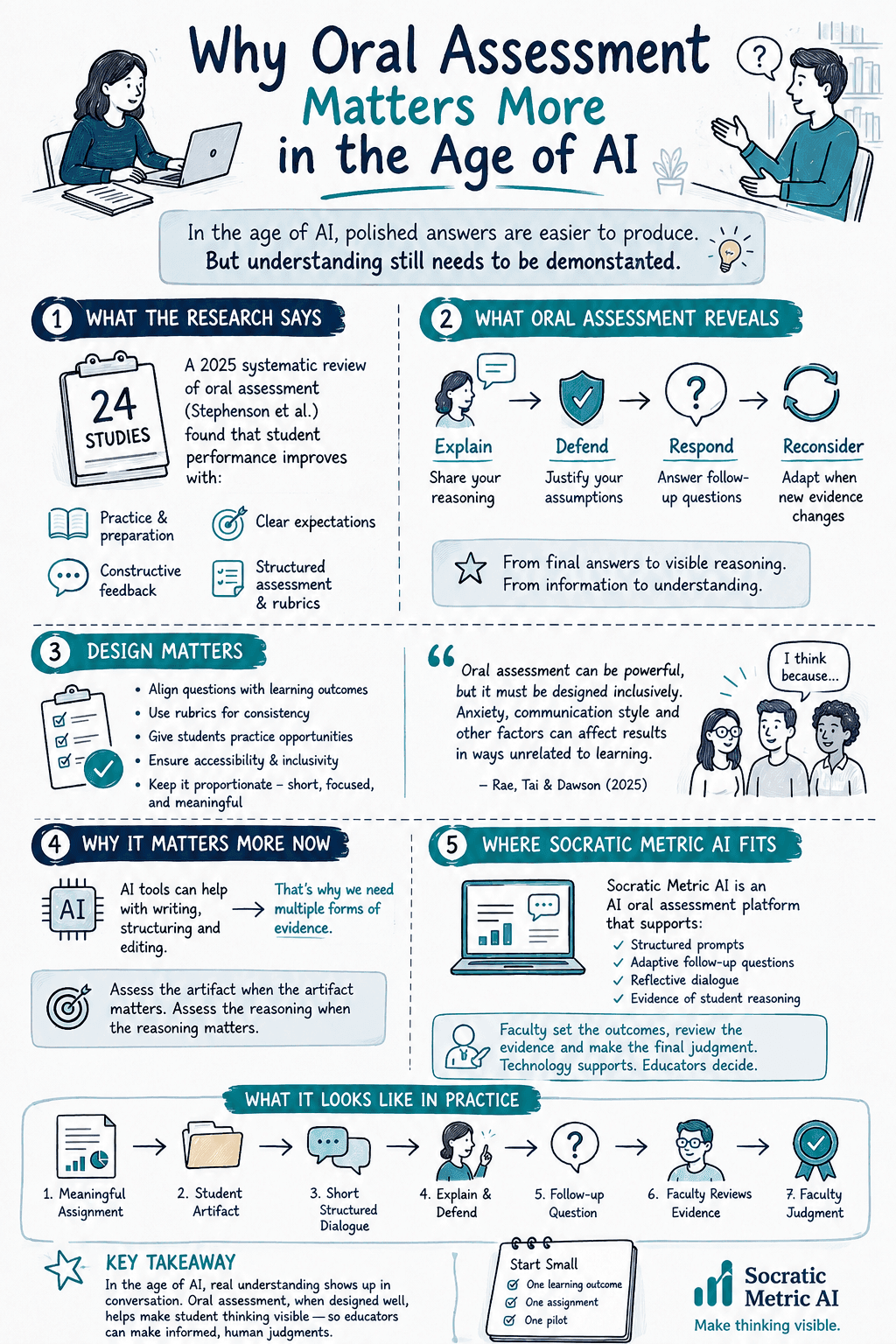
In 2025, researchers Zoe Stephenson, Nicole Johnson Glauch and Sam Cruchley published a systematic review of oral assessment in Assessment & Evaluation in Higher Education. Their review examined 24 studies spanning undergraduate and master's education across multiple disciplines.
Their conclusion was not that universities should simply replace written exams with oral ones.
The more useful finding was about design.
The research identified factors that can help students perform effectively in oral assessment, including practice, feedback, clear expectations, scaffolding and structured approaches to assessment.
In other words, oral assessment works best when it is treated as an assessment method not simply as a conversation added at the end of a course.
That distinction matters now.
Generative AI has made it easier for students to receive help brainstorming, structuring, revising and improving written work. That does not make written assessment obsolete, nor does it mean polished work should be treated with suspicion.
But it gives faculty another reason to ask whether the evidence produced by an assessment actually matches the learning outcome they want to evaluate.
Sometimes, the answer itself is important.
Sometimes, faculty also need to see the reasoning behind it.
Oral Assessment Is About Evidence, Not Just Questions
Imagine a professor teaching a business strategy course.
Students have spent two weeks analyzing a company facing declining margins. One student submits an excellent report recommending that the company exit an underperforming market.
The report is coherent.
The financial argument makes sense.
The recommendation is supported by evidence.
Now imagine adding a short structured conversation.
The professor asks:
“Which assumption matters most to your recommendation?”
The student identifies the expected improvement in margins after exiting the market.
Then comes a follow-up:
“Suppose exiting the market causes the company to lose a major distribution partner in another region. Does your recommendation change?”
The student pauses.
They reconsider the evidence, explain the trade-off and revise part of the recommendation.
That short exchange reveals something the report alone may not.
Not simply whether the student knows the “right” answer, but whether they can connect evidence to a conclusion, defend an assumption and adapt their reasoning when the situation changes.
That is the useful promise of oral assessment.
A well-designed oral assessment is not merely a professor firing questions at a student.
It is a structured opportunity for learners to explain choices, connect concepts, justify assumptions, respond to follow-up questions and demonstrate how they think.
This matters because assessment validity begins with alignment.
If a course claims to develop reasoning, application and judgment, then faculty need evidence of those capabilities.
Written work can provide some of that evidence.
Dialogue can sometimes provide another layer.
The University of Virginia Center for Teaching Excellence now describes renewed faculty interest in oral exams in response to generative AI. Importantly, its 2026 guidance does not present oral assessment merely as a security mechanism. It highlights intentionally designed oral exams as opportunities for learning and instructor-student interaction.
That is a much more useful way to approach the subject.
What the Research Says About Good Oral Assessment
There is a temptation in conversations about AI to jump directly from a problem to a technological solution.
Assessment deserves more care than that.
The 2025 systematic review by Stephenson and colleagues is useful precisely because it focuses on what helps oral assessment work in practice.
Across the 24 studies included in the review, the researchers identified interventions and facilitators associated with oral-assessment performance.
Preparation matters.
Practice matters.
Feedback matters.
Students benefit from understanding what the assessment will require of them rather than encountering an unfamiliar format under high-stakes conditions.
Clear assessment criteria matter too.
A rubric can help make explicit whether faculty are assessing conceptual understanding, reasoning, application, communication—or some combination of these.
This is important because “speaking well” and “understanding well” are not necessarily the same thing.
The assessment has to know the difference.
The University of Virginia's current collection of oral-assessment resources offers several examples of this principle in practice.
One case comes from an upper-level humanities course, where oral communication practice was integrated into the course rather than simply appearing at the final examination.
Another describes short oral exams in online mathematics courses, where the instructor uses follow-up questions to probe understanding and learns from student responses early enough to adapt subsequent teaching.
A Cornell University engineering example takes a different approach again: oral assessment is connected to professional practice, asking students to justify technical choices and communicate disciplinary reasoning.
These examples are different because their learning outcomes are different.
That is exactly the point.
There is no single universal oral-assessment template.
The format should follow the learning outcome.
If students need to interpret evidence, ask them to interpret.
If they need to defend a recommendation, give them something worth defending.
If they need to apply a concept when circumstances change, introduce a meaningful change.
The purpose is not to make the assessment harder.
It is to make the evidence more relevant.
Oral Assessment Has Its Own Validity Problem
This is where the argument needs an important qualification.
Oral assessment is not automatically more authentic, fair or valid than written assessment.
Maria Rae, Joanna Tai and Phillip Dawson made this issue explicit in a 2025 paper in Assessment & Evaluation in Higher Education examining inclusion and validity in oral assessment.
Their analysis raises a fundamental assessment-design problem.
Suppose a course is intended to measure a student's understanding of economics.
If the student's performance is substantially affected by something unrelated to that learning outcome such as anxiety, voice characteristics or aspects of the interaction with an assessor then the assessment may no longer represent the student's economics capability accurately.
That is a validity issue.
The same concern can apply to disability, language difficulties, neurodiversity and other factors depending on what the assessment is intended to measure.
This does not mean universities should avoid oral assessment.
It means they should design it carefully.
Faculty should be explicit about what is being evaluated.
If polished public speaking is not a learning outcome, students should not accidentally be rewarded simply for sounding confident.
Students should know the format and criteria in advance.
Practice opportunities can reduce the disadvantage created by unfamiliarity.
Appropriate accommodations should be designed into implementation.
Questions and follow-ups need enough structure to support consistent faculty judgment.
And oral assessment should be used proportionately.
A university does not need to replace a 2,000-word paper with a 30-minute interrogation.
Sometimes the strongest design may be the paper plus a five- or ten-minute structured conversation.
The artifact provides one source of evidence.
The dialogue provides another.
Faculty interpret both.
That is a much more interesting model of authentic assessment in higher education than simply choosing one format over another.
Why This Matters Now
Generative AI makes this discussion more urgent, but it should not define the entire discussion.
The broader challenge is assessment validity.
If educators want students to demonstrate explanation, reasoning, defense and application, then their assessment systems need ways to collect evidence of student learning that reflects those capabilities.
This is also where trust matters.
Students should not feel that every oral conversation exists because the institution suspects them of misconduct.
Faculty should not have to approach every polished paper as a forensic investigation.
Oral assessment can be framed differently:
Show us how you think.
That changes the relationship.
The conversation becomes part of learning and assessment rather than an investigation into authorship.
For a deeper discussion of why generative AI complicates the relationship between polished work and genuine understanding, see “When AI Can Write Everything, How Do You Know Someone Actually Understands?”
Where an AI Oral Assessment Platform Can Help
There is still a practical problem.
Structured dialogue takes time.
A professor with 25 students may be able to conduct individual conversations relatively easily.
A department with hundreds or thousands of students faces a different operational challenge.
This is where an AI oral assessment platform becomes worth exploring not as a replacement for faculty judgment, but as infrastructure supporting structured assessment.
Socratic Metric AI is designed to support structured prompts, adaptive follow-up questions and reflective dialogue that can help surface evidence of student reasoning.
A student might first explain a decision.
The dialogue can then probe an assumption.
A follow-up can introduce a changed condition.
The student then has an opportunity to explain whether—and why—their conclusion changes.
What matters is what happens afterward.
The technology should not independently decide what learning means.
It should not replace the educator.
It should not turn a conversation into an AI-detection exercise.
Faculty remain responsible for the learning outcomes, assessment criteria, academic standards and final educational judgment.
That distinction is central to responsible AI-assisted assessment with faculty judgment.
Technology can help structure and support the collection of evidence.
Educators decide what that evidence means.
And perhaps that gives universities a more practical starting point than redesigning assessment across an entire institution.
Start with one course.
Choose one important learning outcome where reasoning matters.
Keep the existing assignment.
Add a short, structured oral component.
Define in advance what faculty want to learn from the conversation.
Provide students with clear expectations and appropriate preparation.
Then evaluate the pilot itself.
Did the dialogue reveal useful evidence that the existing artifact did not?
Did students have a fair opportunity to demonstrate what they knew?
Could faculty interpret the evidence consistently?
Was the additional workload proportionate to the value of the information gained?
Those questions put assessment design back where it belongs.
Not around catching students.
Not around defending one assessment format against another.
And not around adopting AI simply because AI is available.
Around evidence of learning.
In the age of generative AI, the strongest assessment may not always be the one that asks students for another answer.
Sometimes, it may be the one that gives them an opportunity to explain the thinking behind the answer they already gave.
References
Stephenson, Z., Johnson-Glauch, N., & Cruchley, S. (2025).
Interventions and facilitators of oral assessment performance in higher education: a systematic review. Assessment & Evaluation in Higher Education, 50(7), 1140–1153.
https://doi.org/10.1080/02602938.2025.2504621
Rae, M., Tai, J., & Dawson, P. (2025)
Giving voice to women students: designing oral assessments for inclusion and validity. Assessment & Evaluation in Higher Education.
https://doi.org/10.1080/02602938.2025.2580622
University of Virginia Center for Teaching Excellence. (2026).
Derek Bruff, Implementing Oral Exams for Learning and Assessment.
https://teaching.virginia.edu/collections/implementing-oral-exams-for-learning-and-assessment
Socratic Metric AI. (2026).
When AI Can Write Everything, How Do You Know Someone Actually Understands?
https://www.socraticmetric.ai/blog/when-ai-can-write-everything-how-do-you-know-someone-actually-understands